
Experimental processing summary
Study ID: CHRS 04
Research question
How do withering, rolling, oxidation, drying and extraction affect coffee-leaf preparations?
Location and scope: Research batches at Copper Hill, Puerto Rico, with collaborating field observations in Nicaragua and brewing trials in Portland, Maine. Published literature from researchers at the University of British Columbia informs the study.
Principal site: Copper Hill, Las Marías & Maricao, Puerto Rico (research batches) · Collaborating sites: Nicaragua (field observation); Portland, Maine (brewing trials) · Related published research: University of British Columbia, Faculty of Land and Food Systems
Approach and context
Coffee leaves are processed at Copper Hill Farm in Puerto Rico in research batches only; no commercial batches are produced there. The program examined withering, rolling, oxidation and drying of coffee leaves. Later trials explored immersion and drip extraction.
- Classification
- Experimental processing
- Research domain
- Botanical Science
- Research site
- Copper Hill Farm, Las Marías & Maricao, Puerto Rico (principal); collaborating sites: Nicaragua (field observation); Portland, Maine (brewing trials). Related published research: University of British Columbia, Vancouver
Data and figures
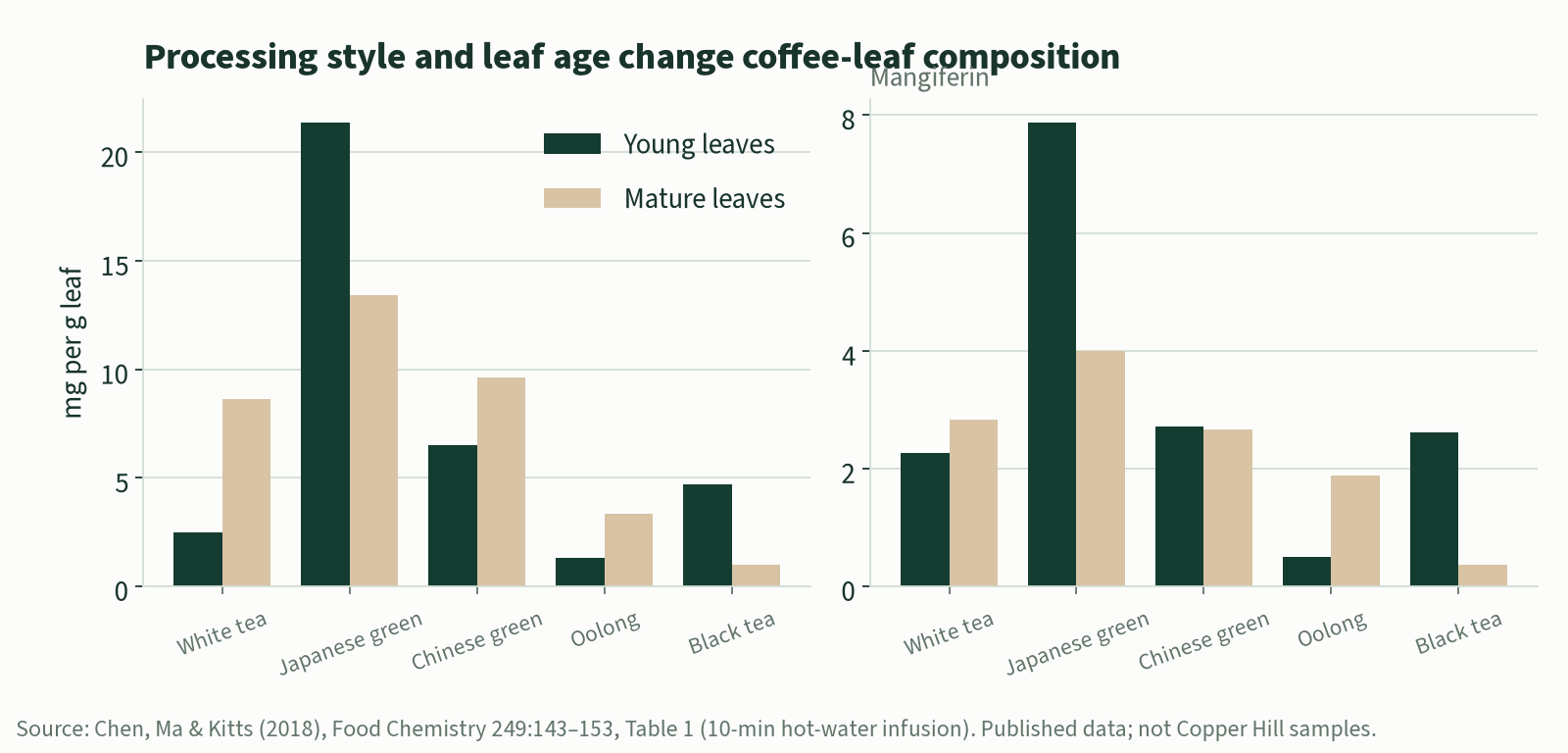
Published research from the University of British Columbia (Chen, Ma & Kitts, 2018) shows why processing conditions matter: Japanese-style green-tea processing of young leaves gave the highest chlorogenic acid and mangiferin, while black-tea processing of mature leaves gave the lowest.
What the record supports
See Coffee Leaf Sensory Analysis and Coffee Leaf Extraction Methodology for the follow-on research protocols.
Leaf age and processing conditions may affect composition and sensory properties.